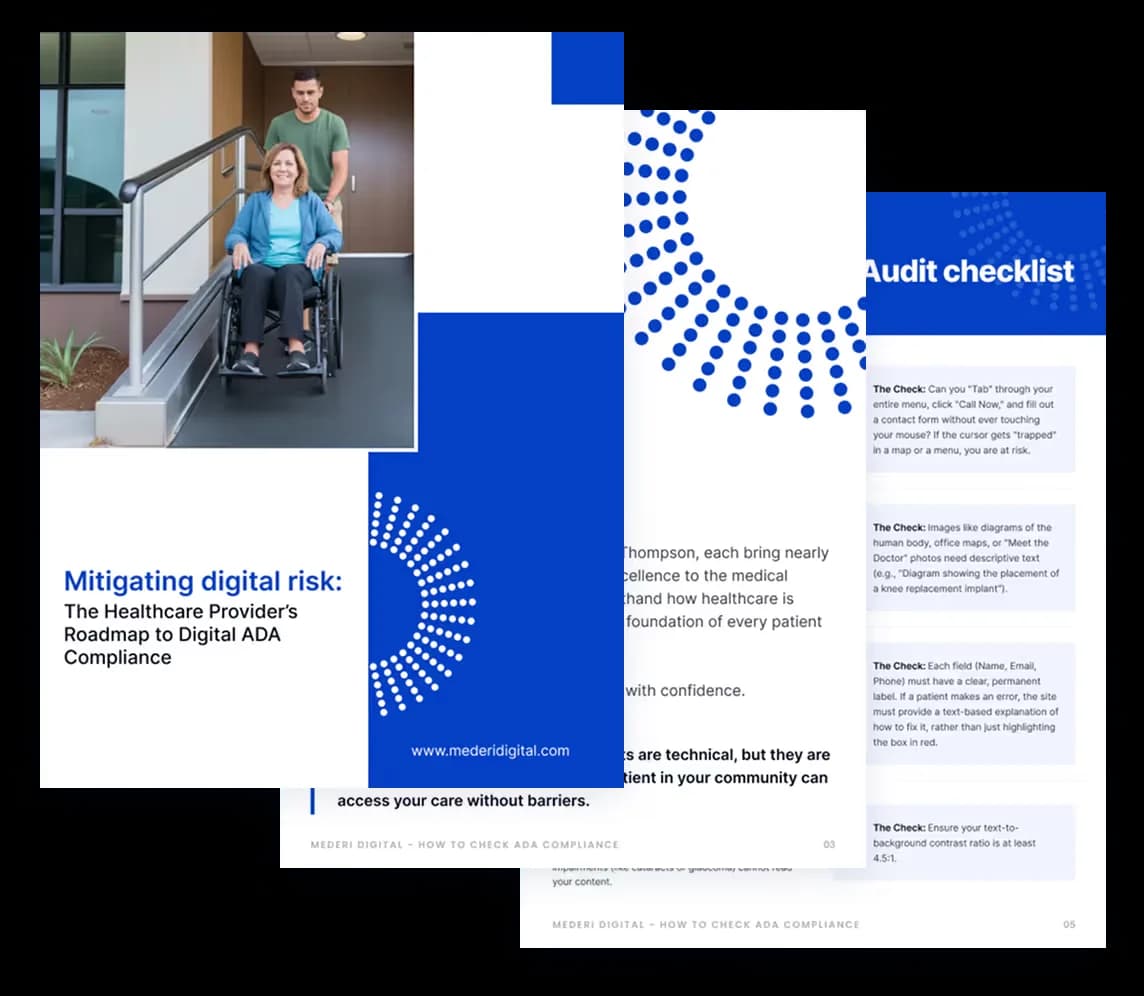
ADA compliance whitepaper cover

Is your practice website ready for the ADA Compliance deadline?

The new HHS accessibility enforcement is here. Non compliant websites could face audits, lawsuits, or loss of federal funding.

The noncompliance clock starts on May 11th, 2026. Make sure your practice is ready.

Congratulations!

You have taken the first step to making sure your practice is ADA Compliant. More importantly, your ADA accessible site is a signal to your community that you and your practice are welcoming and inclusive to everyone. 

If you need help getting your website ADA Compliant, reach out to hello@mederidigital.com. We can get where you need to be.

Oops! Something went wrong while submitting the form.

What you will learn from this whitepaper

  • 10 Technical essentials for WCAG 2.1 compliance
  • Legal liability & the "Vendor Trap"
  • The May 11th Deadeling

What you will get from this whitepaper

  • Actionable 4-phase roadmap
  • Vendor compliance toolkit
  • Technical compliance checklist

Frequently asked questions

Does this deadline apply to my practice if I am private?
opern arrow icon

Yes, if you accept federal funding. While the rule comes from the Department of Health and Human Services (HHS), it applies to any healthcare provider that receives "federal financial assistance." This includes any practice that accepts Medicare or Medicaid payments. If your practice has 15 or more employees, your deadline for compliant website and mobile apps is May 11, 2026. (Smaller practices with fewer than 15 employees have until May 10, 2027).

Note: The "Catch-all": Regardless of your employee count or the specific technical deadline, you are already prohibited from discriminating against patients with disabilities.

This means that if a patient cannot access your services because of a digital barrier, you are legally required to provide a meaningful alternative immediately. You cannot simply wait for the deadline to provide accessible care; the technical deadline just specifies when your website must meet the specific WCAG code standards.

What actually happens if we miss the May 11th deadline?
opern arrow icon

The Office of Civil Rights (OCR) is the enforcing body for this rule. Non-compliance can result in formal investigations and compliance reviews. Ultimately, failing to meet these standars can lead to the suspension of termination of your federal funding (Medicare, Medicaid) and may leave your practice vulnerable to private civil litigation under the ADA.

To be clear, the clock starts on May 11th. Anytime past the deadline, you will be open to non-compliance or potential lawsuites.

We use a third-party company for our "Book Appointment" button. Are they responsible for its accessibility?
opern arrow icon

The legal responsibility lies with you. The HHS rule states that you are accountable for the accessibility of any digital tools you "provide or make available" to your patients. Even if you didn't build the software, if it is a part of your patient's digital experience, you are responsible for ensuring it meets WCAG 2.1 AA standards. We recommend requesting a VPAT (Voluntary Product Accessibility Template) from all your digital vendors immediately.

Do we have to fix every single blog post and image from the last 10 years?
opern arrow icon

Not necessarily. The rule includes a "limited exception" for archived web content. If the content was created before May 11, 2026, and is kept soley for reference or record-keeping (and is not updated), it does not need to be remediated. However, any content currently used to help patients access your services, like your current intake forms, contact pages, and provider lists, must be fully compliant.

Is a "Compliance audit" just a one-time thing?
opern arrow icon

Accessibility is an ongoing obligation. Think of it like a medical license or a building safety inspection. While the audit indentifies your current gaps, you must maintain these standards as you update your site. Any new photos, videos, or pages added after May 11th must be compliant from the moment they are published. We recommend a full professional audit once a year, with automated monitoring in between.